
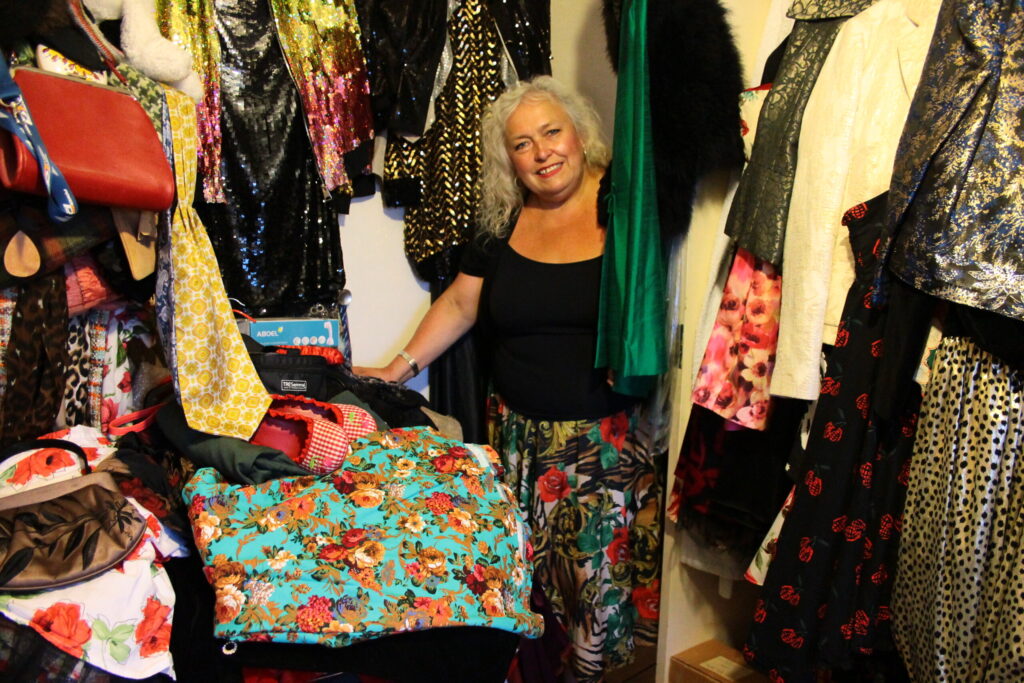
Picture description: A photo of Mandi posing in her bedroom.
We spoke to Mandi, a client of Mary Frances Trust and Advisory Group member, who has lived experience of hoarding and is passionate about supporting others who may be struggling to acknowledge, understand or accept these behaviours.
Here, she shares her personal insights and practical tips for recognising and beginning to address hoarding behaviours.
1. Recognise when hoarding (aka “having too much stuff”) may be affecting your life and potentially others around you
If you have a lot of things and it starts to feel overwhelming — causing anxiety, financial strain, limiting your living space, or making it difficult to have people in your home — it may be a sign that hoarding is affecting you and perhaps others around you.
For me, the key moment was being honest with myself about how much it was impacting my life. I felt depressed and anxious, that I had “lost my sparkle” and I didn’t know what to do about it.
Acknowledging that something isn’t working is the first step towards change.
2. Learn more about hoarding
There is still a lot of misunderstanding and stigma around hoarding. Through my own experience, I’ve come to understand it as something that is often deeply rooted in emotional challenges or traumatic experiences that haven’t been fully addressed or dealt with.
For me, buying things gave me a temporary dopamine boost when I was feeling sad or down. Dopamine is the “feel good” neurotransmitter hormone released by the brain after pleasant activities, such as food, dancing, shopping etc.
Shopping helped me avoid difficult feelings, and potential anxiety, for a moment. But that feeling didn’t last, and so the cycle would repeat itself again and again and became addictive.
Understanding that hoarding is a trauma response, not a personal failing, helped me let go of some of the behaviours and shame, and start focusing on what I needed to face, accept and work through.
I found the book called Understanding Hoarding by Jo Cooke a really helpful place to start to improve my knowledge and understanding.
Clouds End CIC also have a fantastic webpage explaining what hoarding is, with powerful personal stories: What Is Hoarding Disorder? – Clouds End Hoarding Support and Training.
Hoarding UK also have a lot of information and resources available on their website: Hoarding UK | Promoting Choice & Control since 2008.
3. Attend a hoarding support group
Going to a support group was a real turning point for me and started a long journey which I am still on.
My GP suggested I attend a hoarding support group delivered by Mary Frances Trust in Leatherhead. At the time, I was totally in denial and initially scoffed at the idea, but I decided to go because I trusted their advice.
What I found completely changed my perspective.
Everyone present were just ordinary people. There was no judgement — just people who had developed similar patterns around buying and keeping things. That experience helped me recognise my own situation and I started to accept that I needed support.
My “Road to Recovery” could only begin after my “Road of Recognition” had begun.
You can read more about the benefits of hoarding support groups and how to find the right one for you on the Clouds End CIC website: Support Groups – Clouds End Hoarding Support and Training.
Hoarding UK also lists Support Groups and Peer Mentoring on their website.
4. Understand your experiences and triggers
It was important for me to reflect on my past, identify the processes and confront the experiences I had been avoiding — things like personal family loss, relationship breakdowns and emotional challenges that I now realise where part of why I had started to buy, keep and hoard more.
Understanding where my behaviour came from helped me begin to move forward. Support such as counselling (also called Talking Therapy) or Cognitive Behavioural Therapy (CBT) can be really valuable. You can talk to your GP about accessing this or look for NHS-funded self-referral options.
I also had to recognise my specific triggers. For me, it was charity shops, vintage flea markets and car boot sales. It gave me a triple dopamine effect: I loved finding unique items and bargains, I loved other people telling me I had an eye for things and finally, I loved making money from reselling them. Over time, I stopped selling my items and they began to pile up until I didn’t have any room left in my home anymore.
I didn’t realise at the time that my hoarding behaviour was fuelling my anxiety and depression, instead of helping to cure them. I was stuck in a highly addictive cycle that I couldn’t break free from.
5. Shift from compulsive to conscious buying
I realised that completely avoiding the things I enjoyed wasn’t the right approach for me. Charity shops had been a big source of happiness throughout my life, from about the age of 16.
Instead, I worked on changing how I engaged with them. I learned to enjoy browsing without feeling the need to buy. I could appreciate something without owning it – I called it “conscious shopping”.
Over time, I started to get a sense of satisfaction (a healthy form of dopamine), from making conscious choices rather than giving in to the impulse to buy.
6. Get the right support
Having the right support makes a huge difference once you decide to acknowledge, accept and reach out for help to tackle your hoard.
For me, it was important to have someone who understood the emotional connection I had to my belongings, how hard it was for me to let go, and who could support me without judgement. That might be a friend, someone with lived experience, or a professional. Most of all, they do need to have some knowledge of the subject as well as be patient and understanding.
Fortunately, friends helped me take practical steps, like moving some of my things into storages and garages so I could feel less overwhelmed. That gave me the space to start making more changes.
I was then able to take further steps, including opening a shop in Walton-on-Thames in the Heart shopping centre with the help of Rainbow Rising to sell some of my clothes, shoes, items, etc. This helped me move forward in a positive way and have a platform to spread awareness about my story and hoarding in general, as well as help raise funds and awareness for Hoarding UK.
Mary Frances Trust runs a Hoarding Practical Course every year in partnership with SABP, lasting from March to December with set tasks to help you manage the condition and make progress. Registration opens in January each year. The course is full for 2026, but if you would like to join the waiting list for next year, contact info@maryfrancestrust.org.uk, call 01372 375 400 or SMS 07929 024 722. For more information, download the full poster.
I would also recommend the Resources page of Hoarding Awareness Week which has really helpful tools to tackle decluttering at your own pace: Resources – National Hoarding Awareness Week
7. Share your story and help break the stigma
Sharing my experience has become an important part of my journey.
I don’t do it for personal recognition — I do it because I want to help other people know they are not alone and that change is possible. Hoarding can feel isolating, but talking about it helps break down stigma and encourages fellow hoarders to seek support and hopefully find coping mechanisms to manage and escape this life-affecting condition.
If you also feel able, by sharing your story, you could help someone else take their first step to recovery.
I have worked with authors such as Jo Cooke and Amanda Peet who developed the Mind your Mind technique – it changed my life and continues to do so. I have been on TV programmes about hoarding (Channel 5: “Hoarders: Buried Alive”), I am speaking at events, radio shows (I will be on Surrey Hills Community Radio on Wednesday 13 May 2026 between 11am-1pm), I share my story through blogs, social media posts and videos.
I’ve made it my mission to “regain my sparkle” and help as many people as possible regain their own sparkle too.
“My “Road to Recovery” could only begin after my “Road of Recognition” had begun.”
Further Resources
Want to blog for us?
Did this inspire you to share your story and help others on their wellbeing journey? If you would like to contribute to this blog series, please email Connie, our Communications Lead, at connie@maryfrancestrust.org.uk. The blogs can be poems, song or videos – whatever format you feel most comfortable with!